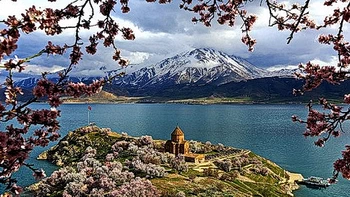
Armenians are among the oldest peoples in the world. They originated in the Armenian Highlands and formed as a distinct nation more than 2,500 years ago. Over the centuries, Armenians have experienced all stages of societal development—from prehistoric communities to capitalism and socialism—and have established their own statehood.
Significant insights into the early period of the Armenian people and their statehood come from foreign sources, including the Sumerians, Hittites, Assyrians, Babylonians, and ancient Persians, dating back to the 25th–14th centuries BCE. The Bible also provides some information regarding Armenians and the Armenian Highlands during the 8th–6th centuries BCE.
The oldest surviving written records of the Armenians and Armenia, with precise dates, are found in the trilingual inscription on the Behistun Rock, commissioned in 520 BCE by Achaemenid King Darius I Hystaspes (522–480 BCE).
Further valuable information about Armenia’s ancient history is preserved in Greek and Roman sources, the earliest of which is attributed to Herodotus (484–423 BCE).
Anthropological description of the Armenians
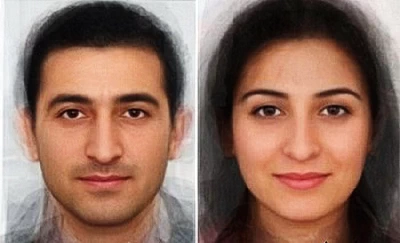
The Armenian Highlands belong to the regions of the Earth where modern humans developed. In this globally significant area, archaeologists have discovered numerous traces of ancient human presence, beginning from the Lower Paleolithic. Permanent population and settlements have existed in the Highlands since the Holocene.
Anthropologists such as Lushan, Shantyr, Virchow, Pantyukhov, Anuchin, Bunak, and others confirm that the indigenous populations of the Armenian Highlands belonged to the Armenoid-Armenian type.
According to anthropologists, the Armenoid type was widely distributed—from the southern parts of Mesopotamia to the upper reaches of the Tigris and Euphrates, westward to the western edge of the Anatolian Peninsula on one side, and to the interior regions of Iran on the other.
Together with other groups, the Armenoids contributed to the formation of several intermediate anthropological types in Europe, India, and the Near East (Litorid, Carpatid, Assyroid, Yemenid, Indo-Brachid). Later migrations further increased their influence in various regions of the world, particularly in Central Europe.
In the territory of historical Armenia, the Armenian people developed and, until the beginning of the 20th century, maintained numerical predominance, making a significant contribution to world civilization.
Distribution and Diaspora
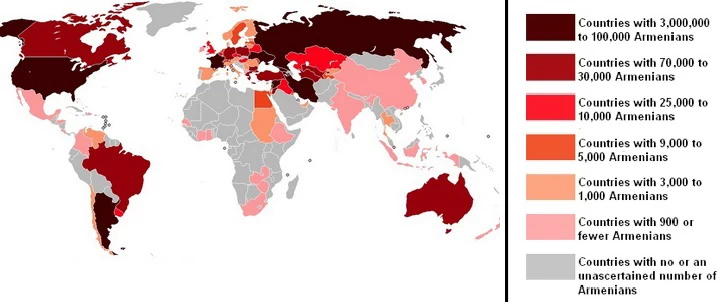
Armenians form the majority of the population in the Republic of Armenia, which is an ethnic state. About 3 million Armenians live there.
Until September 2023, around 120,000 Armenians lived in the territory of Armenia’s second state — the Republic of Artsakh. Due to Azerbaijan’s genocidal policies, this region has been completely depopulated of Armenians.
Due to their complex and long history, a significant portion of Armenians is practically scattered across the world (8–9 million people). The largest centers of the Armenian diaspora are Russia, the United States, France, Georgia, Iran, Germany, Ukraine, Lebanon, Brazil, and Syria.
More than one million Armenians live in Russia (2.5–3 million) and in the United States (1.6–2 million). In the rest of the world, the number of Armenians ranges from several hundred to tens or even hundreds of thousands.
Apart from the diaspora communities in Iran and the former Soviet countries, the other diaspora communities were mainly established between 1894 and 1922 as a result of the Armenian genocide in the Ottoman Empire.
The Faith of the Armenians
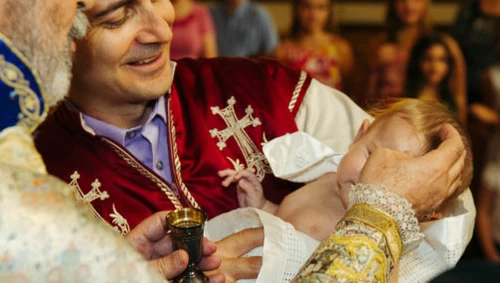
The majority of Armenians are believers and primarily Christians. Most of them follow the Armenian Apostolic Church, which is one of the Eastern Christian churches forming a distinct theological branch.
Christianity was spread in Armenia by two apostles: Thaddeus and Bartholomew. In 301 AD, Armenia became the first state in the world to officially adopt Christianity as its state religion.
The spiritual leader of the majority of Armenians is the head of the Armenian Apostolic Church, the Supreme Patriarch and Catholicos of All Armenians.
A significant portion of Armenians are Catholics, Orthodox, or Protestants. By the end of the 20th century, various sects also gained some presence among Armenians.
A small number of Armenians are Muslims (mainly Sunni). Most of them are crypto-Armenians, who conceal their true origins. They primarily reside in the territory of Turkey, where their number reaches 5–7 million. The crypto-Armenians mainly live in Western Armenia, with some in Cilicia. To survive the genocide, many were Turkified, Kurdified, or Arabized.
The Armenian Language
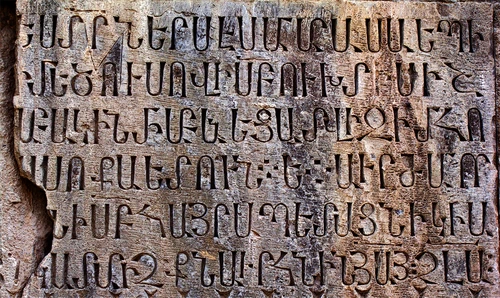
The Armenian language belongs to the Indo-European language family as a separate, independent branch.
The closest linguistic connections have been found with Greek, Indian, and Slavic languages, as well as with Iranian, Phrygian, and Hittite-Luwian languages.
In 405 AD, the prominent scholar Mesrop Mashtots created the national alphabet, which is still used today with almost no changes. The invention of the letters played a crucial role in the development of Armenian indigenous culture, the preservation of ethnic identity, and later in maintaining close ties among Armenian communities.
Today, 7–9 million people speak Armenian worldwide. The language is widely used in the territories of historical Armenia (Javakhk, Persian Armenia, certain regions of Western Armenia) and throughout the Armenian diaspora.
Armenian has two main branches—Eastern Armenian and Western Armenian—each with its own dialects. The primary difference between Eastern and Western Armenian lies in the correspondence of certain letters to their respective sounds.
Armenian has around 50 dialects. Due to the Armenian Genocide and subsequent deportations in 1915, most of these dialects, deprived of their native regions, were lost.